Assessment Payment Collections
Get Paid On Time,
Without Chasing Anyone.
Assessments post, owners get reminded, late fees and interest calculate themselves, and payment plans run without a spreadsheet. Your manager stops making awkward phone calls and the association stops carrying other people’s debt.
Free to use. You only pay a small processing add-on on money you actually collect, and you can pass that to the payer or absorb it.
Delinquency Is a Process Problem
Most Owners Aren’t Refusing. They Forgot.
Collections usually fails long before anyone gets sent to counsel. A statement goes out, nothing happens, and thirty days later somebody has to notice. The association ends up funding the gap out of reserves.
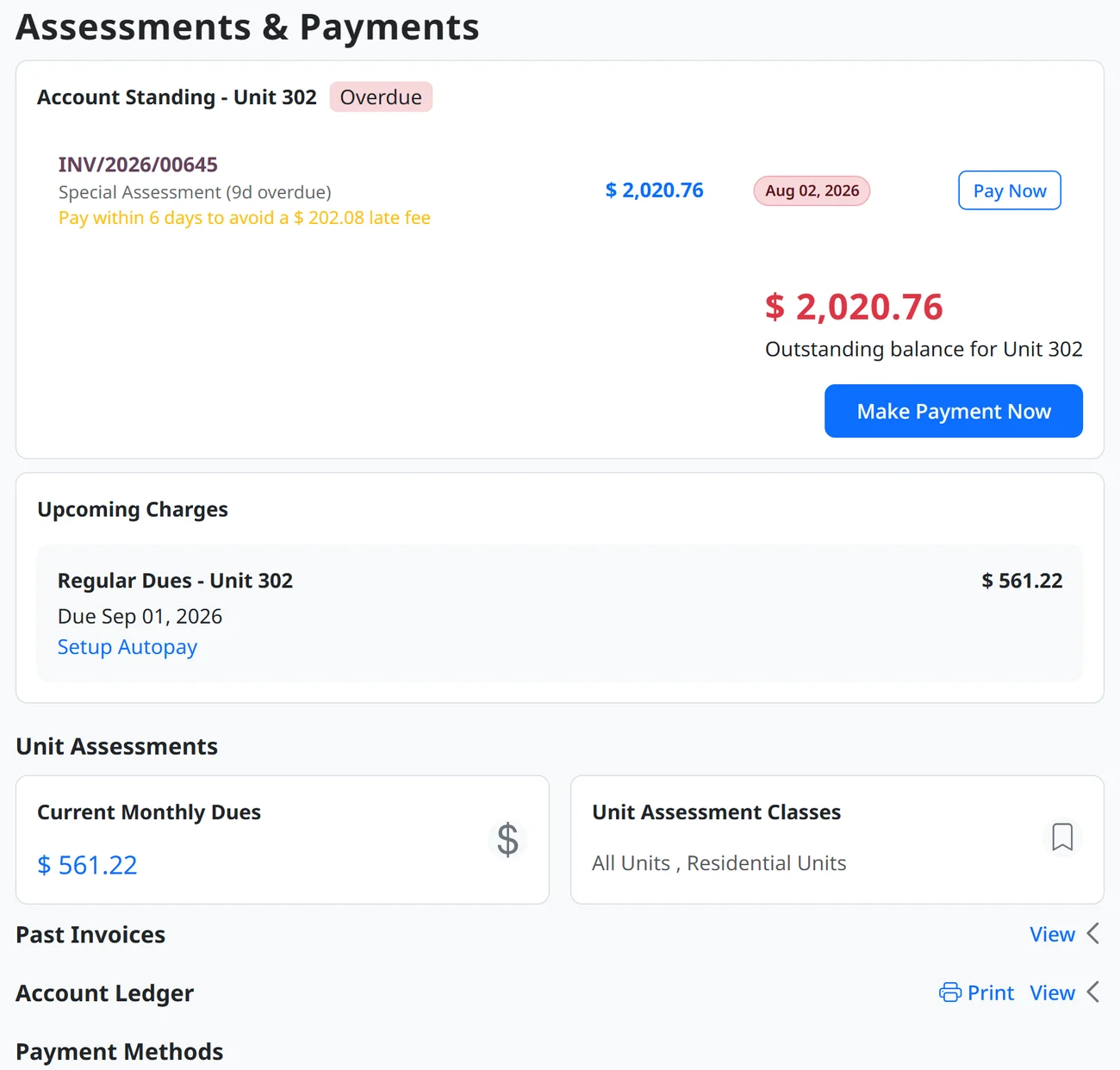
ResLife closes that gap automatically. The owner sees exactly what is owed and exactly what happens if they wait, every time they open the portal. The manager sees only the accounts that actually need a human.
Chasing it by hand
- Export the aging report
- Cross-check who paid
- Draft the reminder
- Look up the late fee
- Post it to the ledger
- Diary the next one
- Do it again next month
What happens instead
- The owner sees the balance and the countdown On their dashboard
- The late fee is assessed at the grace date On schedule
- An overdue account raises a task for staff Only if needed
- That task clears itself when the balance is paid No follow-up
Your Call, Per Payment Method
Pass On the Processing Fee, or Absorb It.
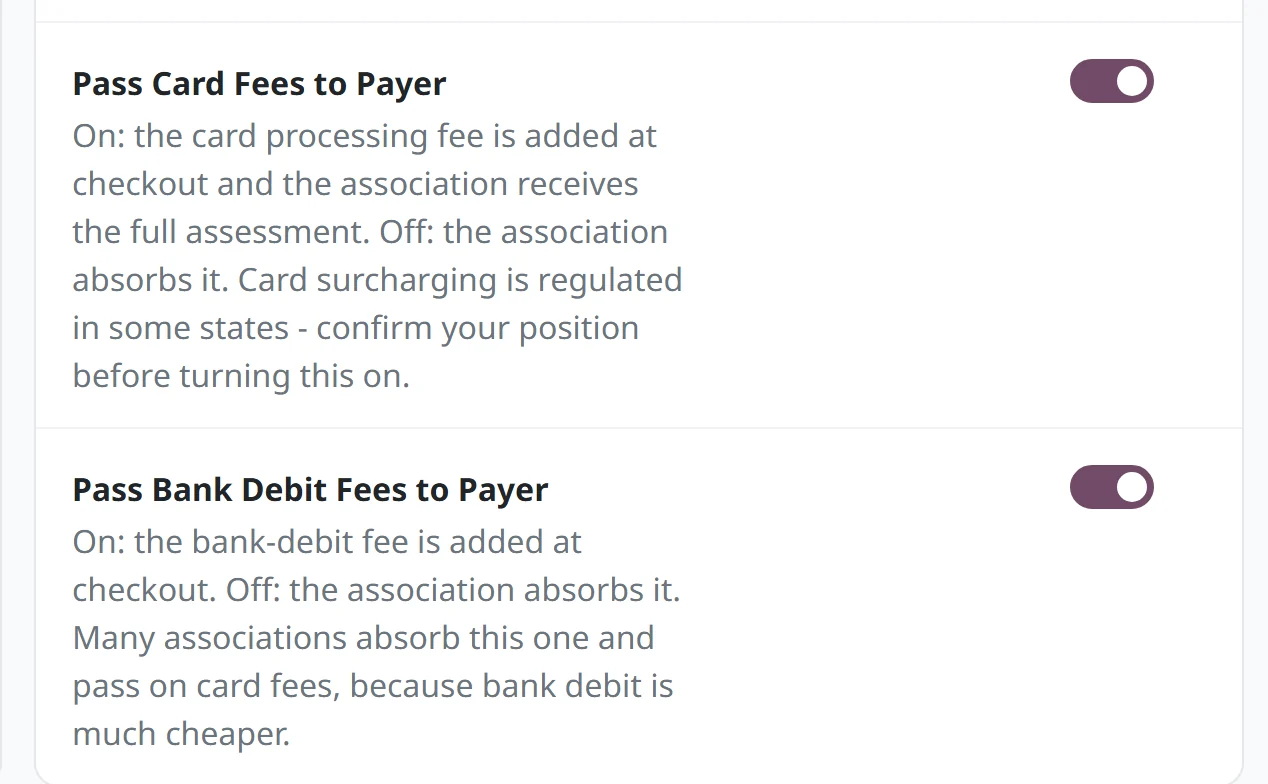
Two independent switches in Association Settings: one for cards, one for bank debit. Turn a fee on and it is added at checkout, so the association banks the full assessment. Turn it off and the association absorbs it.
Most associations pass on the card fee and absorb the bank-debit fee. That single decision steers owners toward the cheaper rail without anyone having to ask them to.
- Separate control for cards and bank debit
- The owner sees the fee before they confirm, never after
- Passed-on fees are grossed up, so the assessment lands whole
Card surcharging is regulated in some US states and by the card networks. The switch is per association so you can set it to match your own position.
Enforcement Without Effort
The Rules Apply Themselves, Exactly As Written.
Grace periods, late-fee caps, and interest ceilings come from your governing documents and your state statute, not from a hardcoded default.
Late fees, calculated nightly
A daily job assesses every overdue receivable past its grace period, books the fee against the original invoice, and respects the cap and floor your documents set. Pay inside the grace window and a fee that was already applied is reversed automatically.
Interest, prorated correctly
Interest is treated as an annual rate and prorated by the days actually outstanding, capped at the statutory ceiling for your jurisdiction. No one has to work out the arithmetic, and no one has to defend it later.
Payment plans that run themselves
Put an owner on an installment plan and the portal shows what is due now rather than the full balance, tracks the next installment and its date, and prompts them to set up autopay so the plan does not quietly fall apart in month three.
Reminders Where They Land
A Nudge Beats a Notice.
The most effective collection message is the one an owner sees before they are late. ResLife puts it in front of them everywhere they already look, in plain language and with a real number attached.
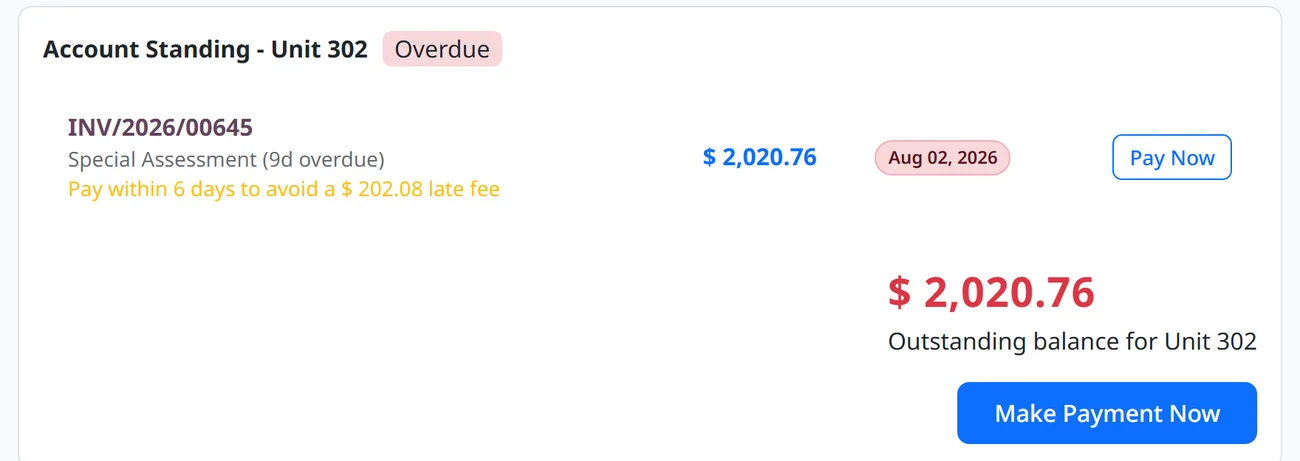
- “Pay within 6 days to avoid a late fee.” The countdown appears on the owner’s dashboard while there is still time to act, with the actual amount attached — calculated from your own cap and floor, not a generic figure.
- The same warning repeats on the financials page, next to the invoice it applies to.
- Overdue accounts raise a task for staff automatically, and clear themselves the moment the balance hits zero.
- Owners without autopay get prompted to set it up, which is the single biggest predictor of paying on time.
Nobody Became a Community Manager
to Chase Checks.
Let the system handle the reminding, the arithmetic, and the paperwork. Save your judgement for the handful of owners who genuinely need it.
FAQ
Collections, Answered.
Can we make owners cover the processing fee?
Yes, and you decide separately for cards and bank debit. With a fee passed on, the amount is added at checkout and the association receives the full assessment. With it absorbed, the association nets the assessment less the fee. Card surcharging is regulated in some states, so the choice is yours to make per association.
Where do the late-fee and interest limits come from?
From your governing documents and your state statute, resolved per association. Grace period, late-fee cap and floor, and the interest ceiling are configuration, not code. Change what your CC&Rs say and the calculation follows.
How is this different from a lockbox or a bank’s AR portal?
A lockbox takes money. It does not know your grace period, cannot assess a fee your documents authorise, will not run a payment plan, and has no way to warn an owner before they go late. ResLife collects inside the system that already holds the assessment, the governing rules, and the owner relationship, so the whole cycle is one process rather than three disconnected ones.
Turn Collections Into
Something That Runs Itself.
Stand up online payments, automatic late fees, and owner reminders for free. You only pay on money you actually collect.