Enterprise HOA Management Software
Getting Live
Live This Quarter,
Not This Time Next Year.
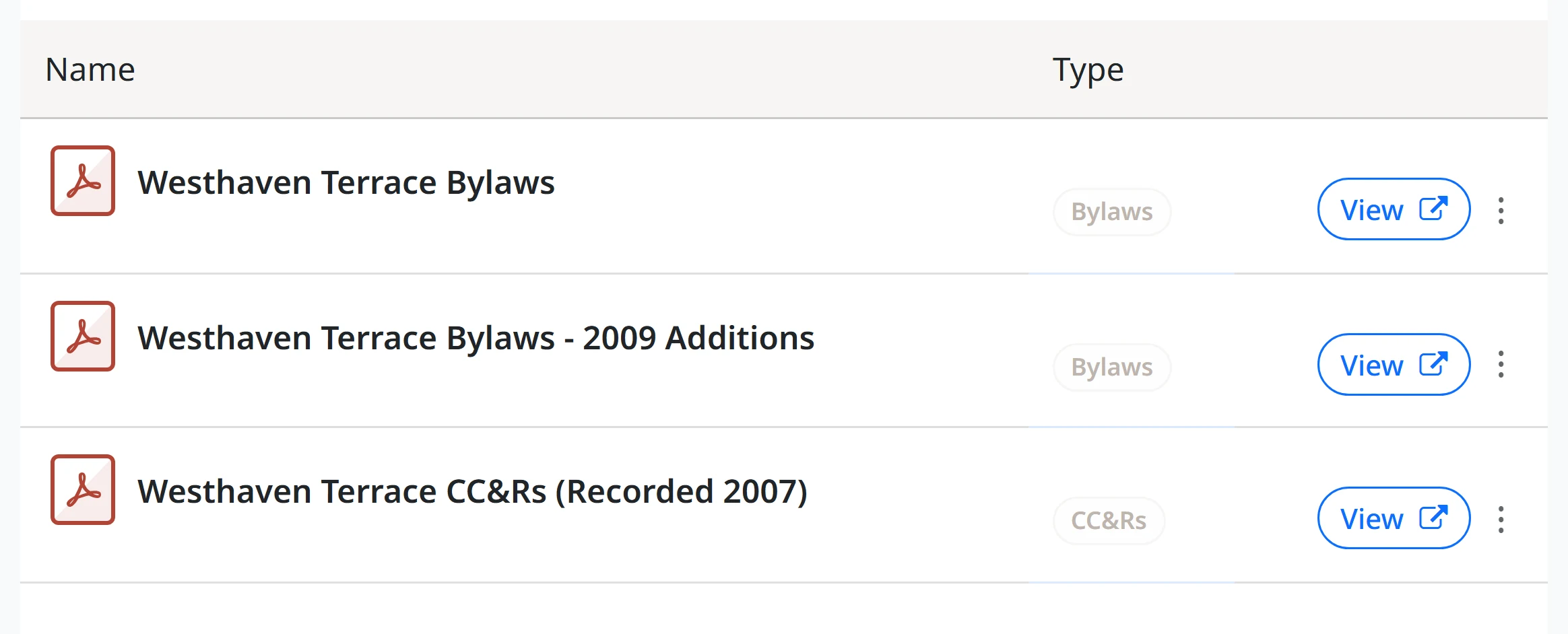
Onboarding is document driven, not conversion driven. You upload the governing documents you are already holding as PDFs, they classify themselves, and the communities, units and people come off your roster. There is no schema to map and no ledger to reconcile before anything works.
It runs community by community rather than as one cutover weekend. The first associations are live in weeks, and the rest follow at whatever pace your team can absorb, because the operational layer sits alongside your accounting system instead of replacing it on day one.
Firms running several legal entities get a supported implementation rather than a self-serve one. That is a staffing decision on our side, not a longer project on yours.
Adoption
Nobody Has To Be
Trained on This.
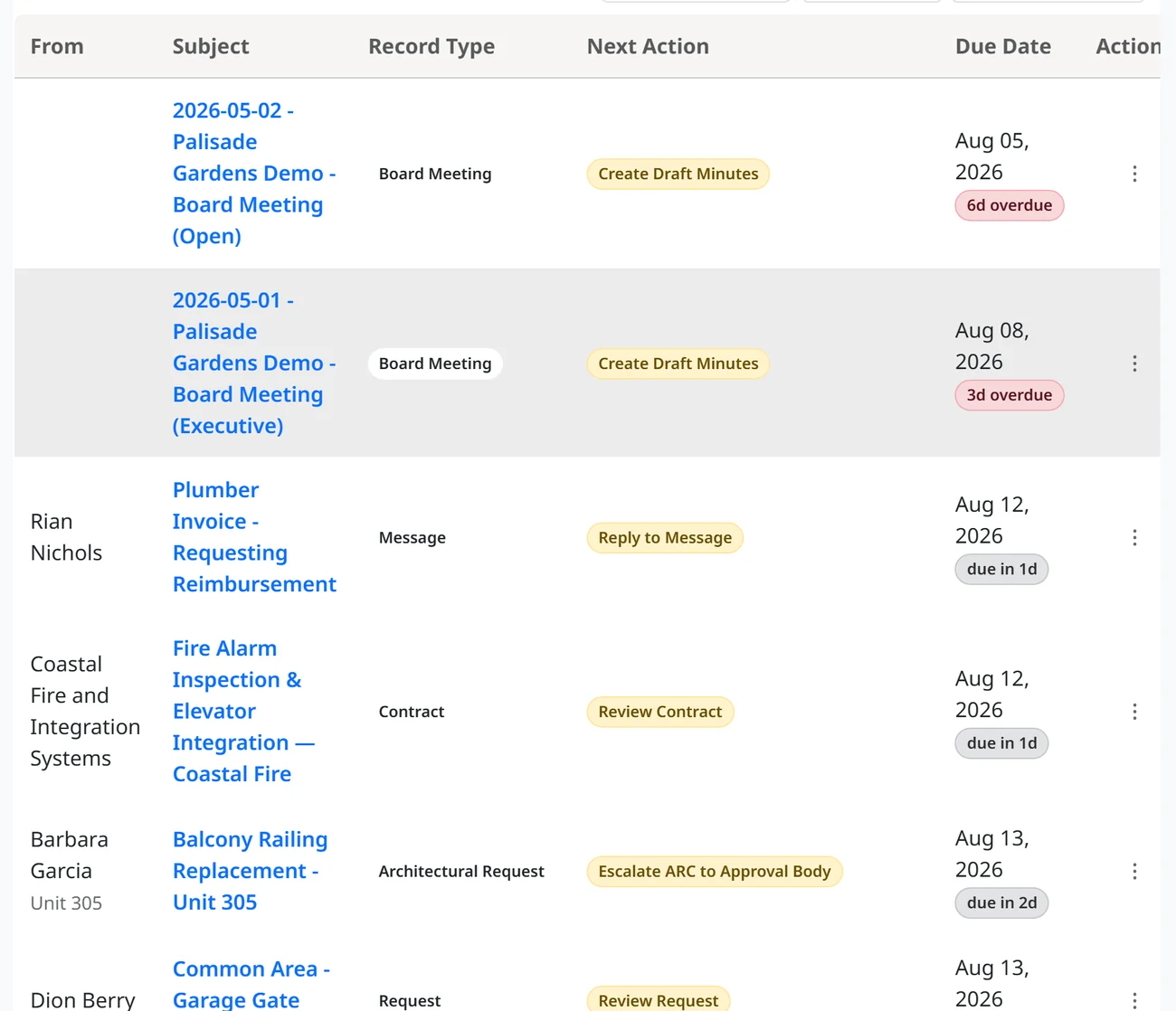
The screen opens on the work that is due, in the order it is due, across the whole book. A manager does not learn a navigation tree to find their day, and there is no module to be certified in before they are useful.
That matters most where enterprise software usually leaks value: turnover. A manager who joins in October picks up somebody else's fifteen associations and the work is where they expect it, because the system organizes around the task rather than around your org chart.
Owners, tenants, board members and vendors are portal users. They never see an admin screen, so nothing about them is a training problem either.
Exposure
Where the
Exposure Sits.
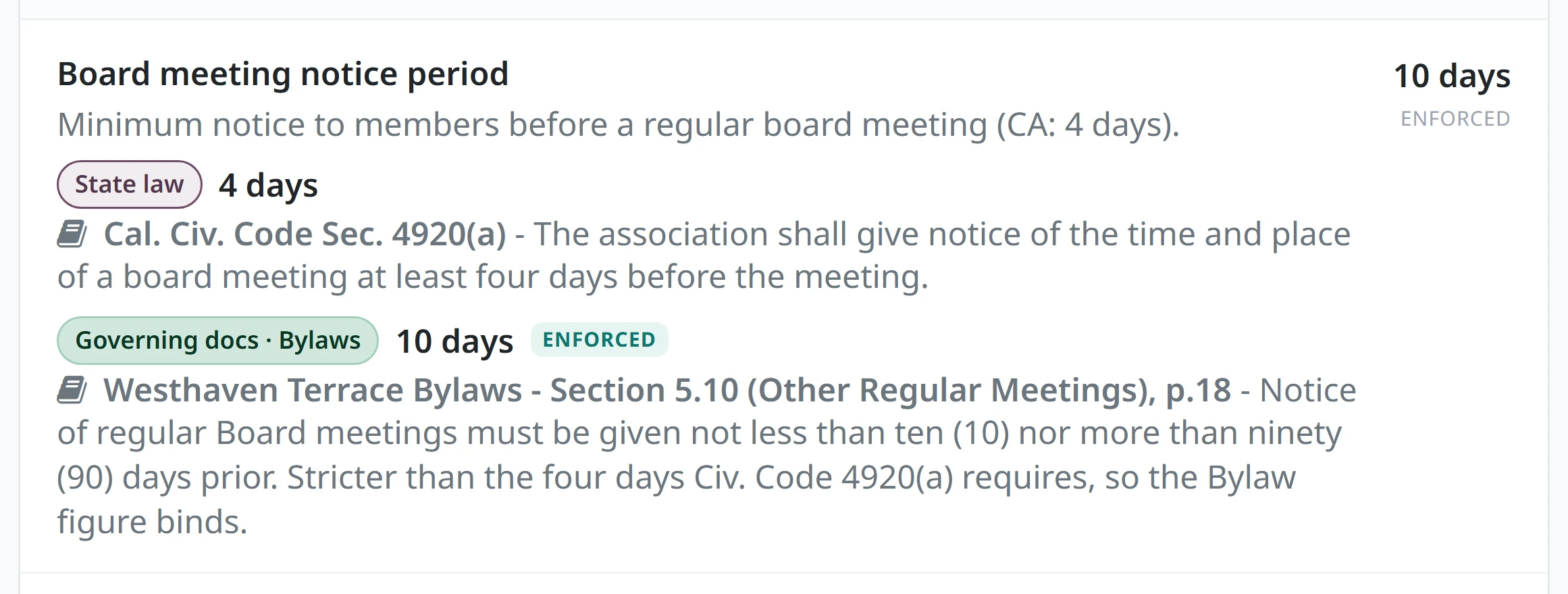
Every limit in your book lives somewhere. In most firms it lives in whichever manager read the most of that association's documents, backed by training that asks people to double-check. You can train a person to double-check. You cannot train them to remember every number in three hundred sets of documents, and every double-check is a cost you pay on every action, forever.
ResLife moves the limit out of the person and into the record: 158 governing values per association today, and growing, resolved from the state's statute and the association's own documents with the stricter one in force, read by every workflow that has a limit to respect, before the action, every time. When a number would break it, the system refuses it and names the authority, quoted. The manager's judgment is spent on the decision, not on remembering the cap.
A control, in the auditor's sense: applied before the act, by the system, with the citation on the record it constrains. The catalog grows as a practice, not a release: when a new use case surfaces, the next value is read out of the documents and built into the logic.
What Runs Itself
The System Does the Part
That Used To Be a Job.
The governing documents are read once, and after that the statute and your own CC&Rs are both in force with the stricter one applied. Nobody looks up a cap. The number that would break it is refused before the vote.
Budgets derive per-unit assessments from the allocation method each association actually uses. Statutory deadlines schedule themselves off the fiscal year. Requests arrive as records on a named person's list instead of in a shared inbox.
Headcount is the largest line in a management firm's cost base. This is the part of the argument that touches it.
Pillar 1 - Infrastructure & Scale
No Ceilings.
No Seams.
Legacy HOA platforms slow down and break because they were built for one association and patched outward as portfolios grew. ResLife was designed multi-tenant from day one - every component scales horizontally with load.
Google Cloud Platform
Hosted on the same infrastructure trusted by the world's largest enterprises. Auto-scaling compute, globally distributed, with built-in redundancy and disaster recovery. No single-server ceiling.
Kubernetes Orchestration
Container-based deployment scales horizontally with demand - no manual server provisioning, no degraded performance during end-of-month assessment cycles or board meeting seasons. Load spikes are absorbed automatically.
Odoo ERP Backbone
Built on Odoo - backed by Sequoia Capital and Blackrock, running tens of thousands of enterprise deployments worldwide. A battle-tested core with a 20-year development history and a global contributor community. Not a startup experiment.
Continuous Deployment
Professional-grade CI/CD pipelines ship tested, reviewed updates continuously - no maintenance windows, no session disruptions, no quarterly upgrade cycles. Your platform improves in real time.
Native-First Architecture
Every core workflow - assessments, board meetings, violations, work orders, ARC - runs natively inside the platform. Third-party integrations exist only at the edges (payment gateways, print/mail services). Their latency or downtime cannot break your operations.
Multi-Tenant Isolation
Each association operates in its own data context. One association's load, configuration, or data anomaly cannot affect another. Isolation is enforced at the data model level - not managed by application-layer filtering that can be misconfigured.
Pillar 2 - Data Architecture
Designed for Maximum Complexity.
Experienced as Simplicity.
The data model was built for the hardest case - a large regional portfolio with hundreds of associations, thousands of units, and dozens of staff - while presenting each user with only the context that is relevant to them.
Record-Threaded Communications
Every association has an email alias - but not an email inbox. Inbound messages thread on the underlying record they belong to: a work order, a violation, an ARC request, a board meeting item.
Every message is visible to all authorized agents of that association. No single-manager silos. No context lost when staff changes. The record holds the full conversation history - permanently.
Role-Based Access Control
Access is configurable at three levels: the organization, the association, and the individual unit. A manager assigned to five associations sees exactly those five. Board members see their association's governance and financial summaries - nothing else. Residents see only their unit's data.
Back-office accounting staff operate in the ERP backend. All community-facing roles operate in purpose-built portal surfaces. Strict separation by architecture, not convention.
Complete Audit Trail
Every action, every message, every state change is logged with timestamp and user identity - not just for compliance, but for the institutional memory that survives staff turnover and board transitions.
Violation notices, board votes, contract awards, and rule adoptions are all audit-logged with the full context that produced them. Every decision is defensible. Every record is complete.
Session-Persistent User Context
Each portal user maintains an active context record - their selected association, active unit, and portal surface are preserved between sessions. A manager juggling 30 associations can switch context in one click and return to exactly where they left off.
The platform always knows who they are, what they manage, and what they last worked on. Context-switching is a click, not a workflow.
Pillar 3 - Financial Architecture
A Real General Ledger.
Not a Billing Module with a COA Attached.
Most HOA platforms were built by developers who bolted an accounting module onto an assessment collection tool. The result is shallow - adequate for simple bookkeeping, insufficient for the financial rigor that professional management companies require.
Full General Ledger Replacement
ResLife.app is designed as a complete general ledger replacement - not a supplement to QuickBooks or a parallel system that requires reconciliation at month-end. Each association maintains its own fully independent set of books. Operating funds, reserve funds, and special assessment accounts are handled correctly by design.
During the migration period, period-close data is bulk-imported to preserve historical books. Your accountants never lose continuity - prior year actuals are available from day one for budgeting and reporting.
GAAP-compliant from day one. The US HOA Chart of Accounts template is built in - fund accounting, operating vs. reserve separation, and assessment income recognition are handled correctly out of the box.
Analytic accounting. Keep your COA clean and simple. Analytic dimensions let you slice the same financial data by association, project, fund, capital improvement program, or any dimension you define - without COA bloat. The roll-ups your finance team needs, without the complexity your accountants dread.
Automated Bank Statement Reconciliation
Statement lines are matched to journal entries automatically. Exceptions surface for human review. Not the reverse - your accounting staff should be reviewing exceptions, not performing the matching themselves.
Automated Merchant Account Reconciliation
Every payment transaction is reconciled against the gateway automatically. Processing fees, chargebacks, and settlement timing differences are accounted for without manual matching by accounting staff.
Automated Collections & Dunning
Configurable late fee schedules, escalating notice sequences, and payment plan workflows - triggered automatically from delinquency thresholds. No manual tracking required.
Print & Mail Integrations
For statutory notices requiring physical delivery, the workflow stays inside ResLife - physical production routes to a print/mail integration at the edge.
Pillar 4 - Native Intelligence
Intelligence Embedded
in Every Record.
"AI-powered" is meaningless when it's a third-party widget with no access to your data. Every AI capability in ResLife is native - it reads from the actual records, governing documents, and operational history of each specific association.
Governing Document Intelligence
Upload CC&Rs, bylaws, and state statutes. AI extracts compliance obligations, translates dense legal language into plain English, and seeds the activity rules engine with required deadlines and notice periods automatically. The system reads your documents so your managers never have to search through them.
Draft Generation - Everywhere
Every action in the system can generate an AI draft: violation notices, rule proposals, board meeting summaries, replies to owner inquiries. Drafts are built from the record's context, governing documents, and prior correspondence - not from a blank page. Managers review and refine. They no longer originate.
Resident Knowledge Agent
An AI assistant configured per association. Residents ask questions and receive answers sourced directly from that association's governing documents and operating rules. Staff never see the question. The answers are accurate, association-specific, and available 24/7.
Contract Intelligence
AI reads uploaded vendor contracts and populates key terms, renewal dates, and obligation flags automatically. Contract records are complete from upload - not manually entered line by line. No more missed renewals buried in PDF attachments sitting in an inbox no one monitors.
Budget Drafting Assistant
Because every board decision is digitized in the system, the AI budget assistant drafts the annual budget using current contract values, approved spending changes, prior year actuals, and reserve study data. Start from accurate numbers - not last year's spreadsheet copied over with a new date.
Migration & Onboarding Intelligence
AI maps source data to the ResLife schema during migration, generates staff training materials from configured workflows, and compresses the onboarding timeline. The system learns your operation as it's being set up - reducing the time between contract and go-live.
Pillar 5 - Portfolio Intelligence
See Every Community.
In One View.
When all operational data lives in one system, portfolio-level intelligence becomes possible for the first time. Not spreadsheet roll-ups - live dashboards built from the data your managers generate every day.
Cross-Association KPI Dashboard
Delinquency rates, open violations, pending ARC requests, budget variance, and collection efficiency - across every association in your portfolio, at a glance. No exports. No pivot tables.
Community Health Scoring
Algorithmic health scores per association, flagging at-risk communities before they escalate to board complaints or contract loss. Proactive management at portfolio scale.
Manager Performance Analytics
Workload distribution, response time, resolution rates, and activity completion rates by manager - actionable data for COO decision-making, not a gut feeling about who is stretched thin.
What It Costs
One Rate, Published.
Everything Else Is Itemized.
A dollar per unit per month. That is the rate at every tier and at every size, with no volume bracket to negotiate into and no door minimum to clear. It is the same number whether you carry four thousand doors or forty thousand.
$250 / month
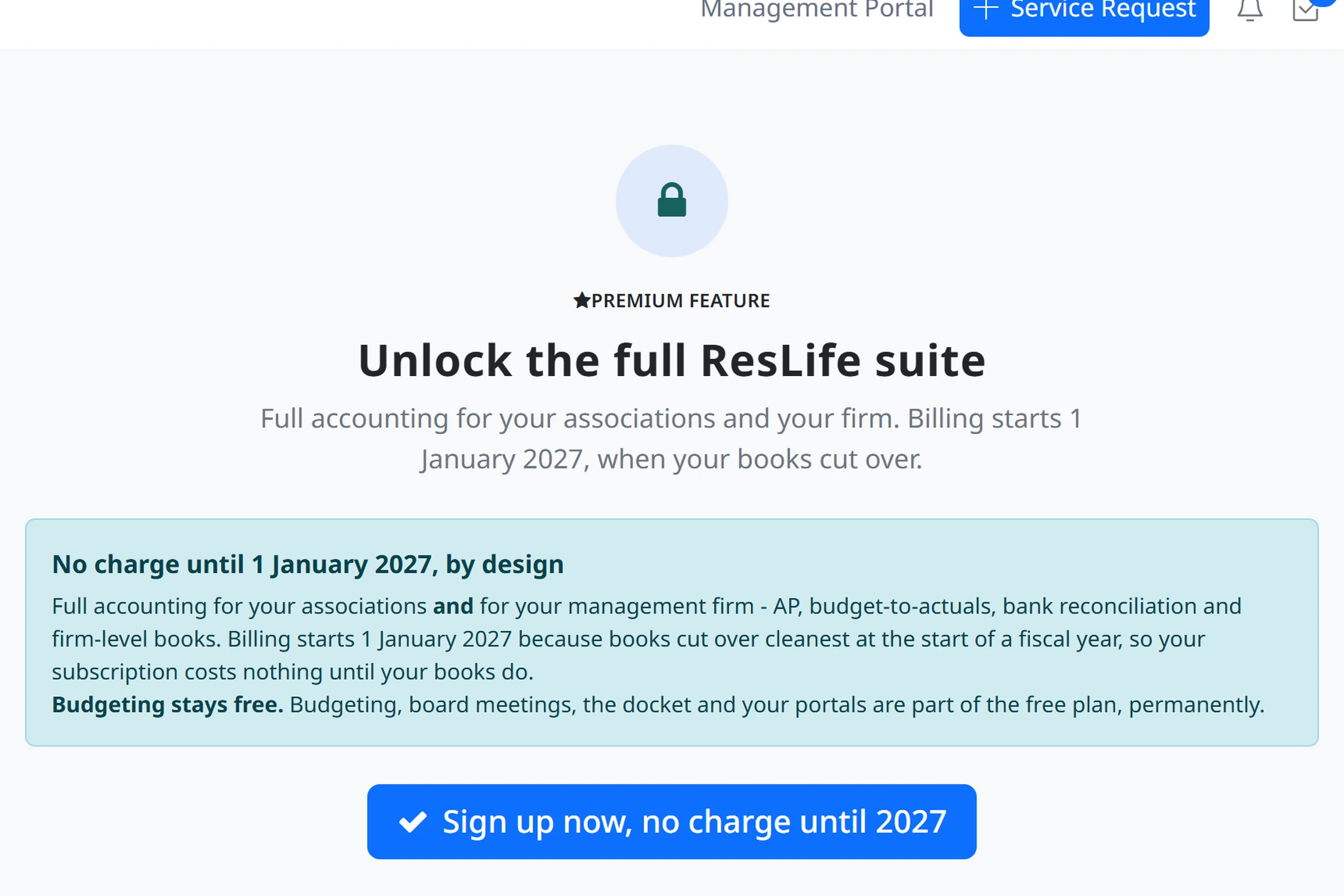
Per firm legal entity, for your own books. Per entity and not per firm: a management LLC and a maintenance LLC are two. Launch offer: the first entity is free through 2027, migration included.
$2,500 / month
Dedicated infrastructure. Optional, and the only thing that separates Enterprise from Business.
$125 / hour
Support, drawn as you use it. No retainer, no included block you paid for and did not spend.
You can read your whole bill off this page. That is deliberate, and it is the part an incumbent cannot match without republishing its own pricing model.
Optional
What the Dedicated
Tier Actually Buys.
An isolated database with its own namespace and route, so your upgrade window is yours and a busy neighbor is not your problem. A sandbox that matches production, so a change is rehearsed before anyone sees it.
An uptime SLA carrying service credits, which is a commitment with a number attached rather than a paragraph. White labelling on your own domain, so clients sign in at your address and not ours.
And customization to how your firm actually works: your own fields, workflows and reports. That is possible precisely because the database is isolated, which is why it lives on this tier and not below it.
Take none of it and you are on Business at the same per-door rate. The operational layer does not change.
Every Claim Is Verifiable
See It Running Under Load
With Your Actual Workflows.
The 14-Day Challenge is the technical review. Name your most complex processes - the ones your current platform handles poorly at scale. We configure ResLife for your specific workflows and run them live. No commitment. No migration. Just evidence.
Want the platform itself, not a tier of it? See the white-label, region-exclusive license →