
Start with the fact that surprises most people, including plenty of board members: your assessment is a byproduct of the budget. Nobody is supposed to pick your monthly number. The association builds a budget, the governing documents say how its costs are shared, and your assessment falls out of that math.
The budget is the source document. The assessment is its output. Which raises the obvious question: what math?
The derivation, in one line
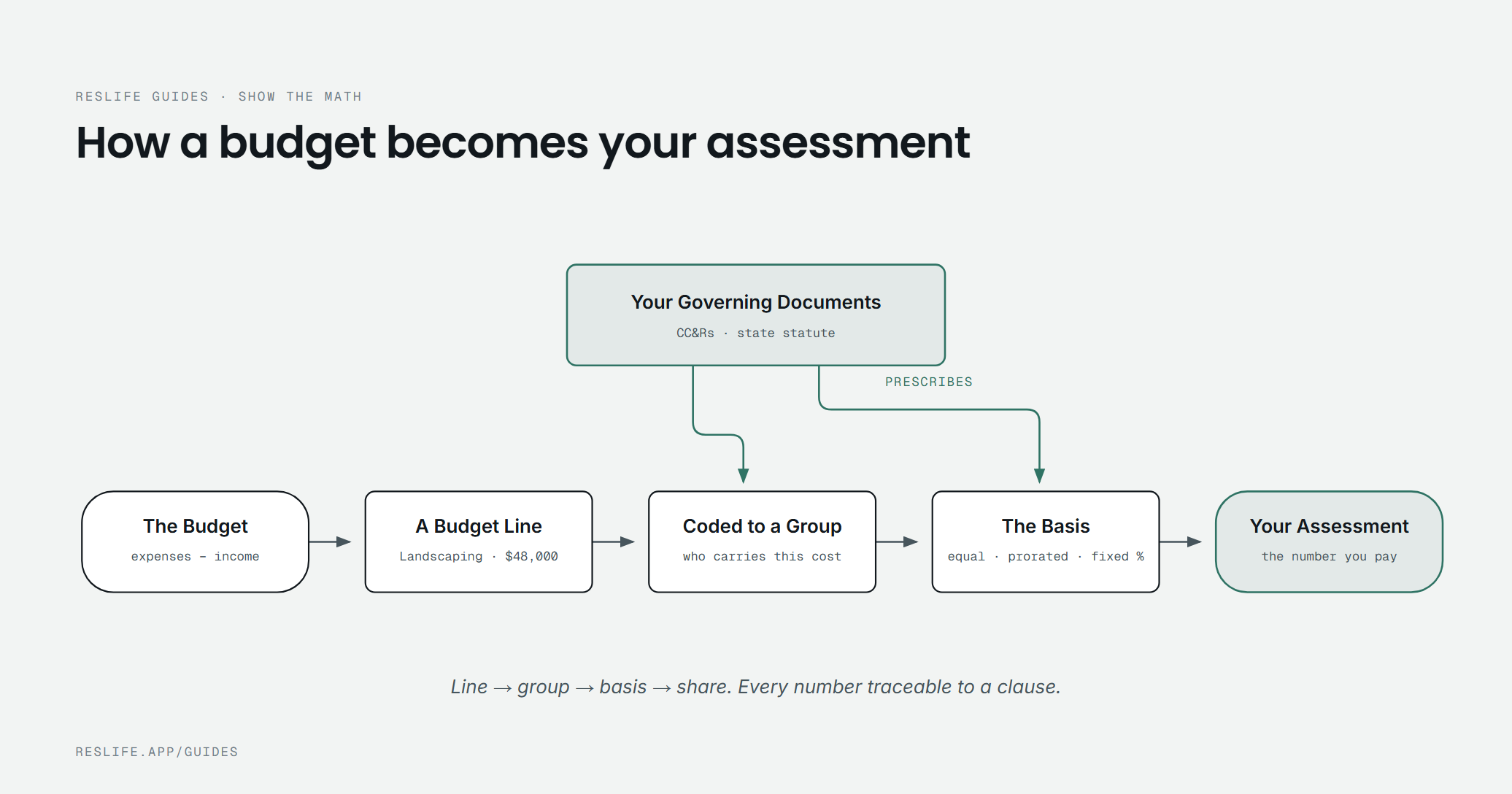
Expenses − offsetting income = the amount to assess → each line coded to its responsible group → distributed on the basis the CC&Rs prescribe → your share.
In this guide
Step one: the budget produces a total
The association adds up next year's expenses, subtracts the income that is not assessments (interest, leases, fees), and what remains is the amount members must fund. That remainder, not the gross expense number, becomes the regular assessment.
Step two: someone must be responsible for every line
The budget alone cannot tell you your portion, because an interpretation step stands between the total and your number. For each line: which group of members carries this cost?
In many associations the answer is simple: one core expense group, everyone shares everything. In mixed-use and master-planned communities it gets harder: some costs belong to everyone, some to a building, some to the commercial units, some to whoever benefits from a specific amenity. Your CC&Rs decide, and this coding of each line to its responsible group is where most of the real skill in budgeting lives.
Step three: the basis, one of exactly three
Once a line has its group, it distributes to that group's members on one of three bases. Take a $1,200 annual line across 120 units:
| Basis | How it works | The $1,200 line becomes |
|---|---|---|
| Equally | One share per unit, identical for all | $10 per unit, every unit |
| Prorated | By unit size or another measure of scale | More for the 2,400 sq ft unit, less for the 800 sq ft unit |
| Fixed percentage | Each unit carries a stated percentage from the documents | Each unit's stated share, with a prorated character usually baked in |
Which basis applies is not the board's mood and not tradition. It is prescribed by the governing documents, sometimes explicitly per category of expense, sometimes left to the board to decide at budget time, in which case the deciding should be done on the record rather than by habit.
The missing thread
Here is where it breaks. When the budget is released and the per-unit assessments appear beside it, nothing connects them. The total is on one page, your assessment is on another, and the math between them lives nowhere.
The anger at the annual meeting is rarely about the amount. It is about the thread.
An owner who cannot see the derivation assumes there is not one. A board that cannot produce it cannot defend a number it may have derived perfectly correctly. A complete budget release shows the chain for every unit: line, group, basis, share. Printable, checkable, boring.
What the law says
California leans the same direction: the annual budget report (Civil Code § 5300) exists precisely so members can see the numbers behind their assessment, and it must reach them 30 to 90 days before the fiscal year begins.
The advanced case, and a word about jargon
If your community is mixed-use or master-planned, the coding step runs through allocation language that even professionals stumble on. When I rebuilt my own association's budget, I hit a clause prescribing a "base equal" allocation and realized the document had an exact intention that nobody in the building could state. Terms like base equal, proportionate share, benefited properties, and limited common expense each carry a specific answer to "who pays." They are readable. They are just written in a register nobody reads voluntarily.
This is also the one place where modern AI genuinely earns its keep in budgeting, used in a targeted way: interpreting the documents' allocation language and loading that meaning into a system that then runs the computations. The reading can be assisted, and note how new that is: software that can tell you what a clause means, rather than merely find its words, only recently became reliable enough to lean on. The math must be deterministic: the same inputs producing the same assessments every time, traceable to the clause that prescribed them.
An interpretation you cannot audit is an opinion. A derivation you cannot reproduce is indefensible in the meeting where it matters.
Last, and only last: the cap
What the law says
California caps a board's increase to the regular assessment at 20 percent over the immediately preceding fiscal year's (Civil Code § 5605(b)), with membership approval required beyond it.
The cap is a ceiling on the derived outcome. It is not a method for setting dues, and a flat 20 percent on every unit is not a budget. If your increase is exactly 20 percent, ask to see the budget that produced it.
The payoff
An association that shows the math changes the character of its own meetings. The question "why is my assessment this amount" gets a clause, a line, and arithmetic instead of a shrug. Owners stop suspecting and start checking. Boards stop defending and start explaining. The number is the same number. The trust is not.
In the interest of transparency: this is the gap my company works on. We offer a free, easy-to-use tool governed by your association's own documents. It ensures every budget line is properly coded, who is responsible and on what basis it is shared, as the documents direct, or as an explicit board decision where the documents leave that to the board. The math underneath is deterministic. The method above works with or without it.
Sources: Cal. Civ. Code § 5300 (annual budget report) · § 5605 (assessment caps).
